Green Synthesis of Gold Nanoparticles using Extracts of C. guianensis: A Comparative Analysis of Reduction Efficiency and Antimicrobial Properties
DOI:
https://doi.org/10.5281/zenodo.17292348Keywords:
green synthesis, bacteria, biosensingAbstract
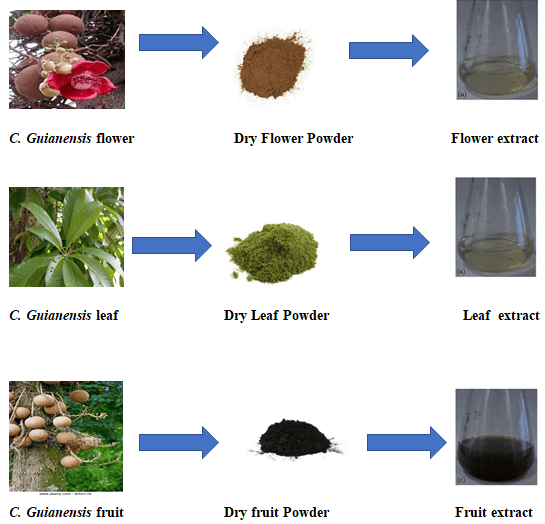
A growing body of research highlights the potential of plant-mediated synthesis for producing gold nanoparticles (AuNPs) in an environmentally friendly manner. However, a knowledge gap exists regarding the comparative effectiveness of different plant parts in facilitating this process. This study addresses this gap by investigating the AuNP synthesis potential of C. guianensis leaf, fruit, and flower extracts. Our results show that these extracts can be successfully utilized for the rapid, one-pot synthesis of AuNPs with controlled size and morphology. A comprehensive characterization of the synthesized AuNPs was performed using a range of analytical techniques, including UV-vis spectroscopy, FESEM, DLS, XRD, and FTIR analysis. Furthermore, the antimicrobial activity of the synthesized AuNPs was evaluated, revealing a minimum inhibition concentration (MIC) of 0.048 mM against Gram-negative bacteria (E. coli).
Downloads
References
Ahmad P., Mukherjee S., Senapati D., Mandal M. I., Khan, R. (2003). Extracellular biosynthesis of silver nanoparticles using the fungus Fusarium oxysporum. Colloids Surf. B, 28, 313–318.
Aizpurua J, Hanarp P, Sutherland DS, Kall M, Bryant GW, & Garcia de Abajo FJ. (2003). Optical properties of gold nanorings. Phys Rev Lett, 90, 057401-1–057401-4.
Huang XH, Jain PK, EI-Sayed IH, & EI-Sayed MA. (2007b). Gold nanoparticles: interesting optical properties and recent appli cations in cancer diagnostic and therapy. Nanomedicine, 2, 681–693.
Ankamwar B, Chaudhary M, & Sastry M. (2005). Gold nanotriangles biologically synthesized using tamarind leaf extract and potential application in vapor sensing. Synth React Inorg Met Org Nano Metal Chem, 35, 19–26.
Chandran SP, Chaudhary M, Pasricha R, Ahmad A, & Sastry M. (2006). Synthesis of gold nanotriangles and silver nanoparticles using Aloe vera plant extract. Biotechnol Prog, 22, 577–583.
Deshpande R, Bedre MD, Basavaraja S, Sawle B, Manjunath SY, & Venkataraman A. (2010). Rapid biosynthesis of irregular shaped gold nanoparticles from maccrated aqueous extracellular dried clove buds (Sygyium aromaticum) solution. Colloids Surf B: Biointerfaces, 79, 235–240.
Huang J, Li Q, Sun D, Lu Y, Su Y, Yang X, Wang H, Shao W, He N, Hong J, & Chen C. (2007a). Biosynthesis of silver and gold nanoparticles by using novel sun-dried Cinnamomum camphoraleaves. Nanotechnol, 18, 105104–105114.
Mirkin CA, Letsinger RL, Mucic RC, & Storhoff JJA. (1996). DNA-based method for rationally assembling nanoparticles into macroscopic materials. Nature, 382, 607–609.
Philip D. (2010). Green synthesis of gold and silver nanoparticles using Hibiscus rosa sinensis. Physica E, 42, 1417–1424.
Rao CNR, Cheetham AK (2001) Science and technology of nanomaterials: current state and future prospects. J Mater Chem., 11, 2887–2894.
Lawrence Anna Sheba, & Venkatraman Anuradha. (2020). An updated review on Couroupita guianensis Aubl: a sacred plant of India with myriad medicinal properties. J Herbmed Pharmacol., 9(1), 1-11.
Sen IK, Maity K, & Islam SS. (2012). Green synthesis of gold nanoparticles using a glucanofanedible mushroomandstudyofcatalytic activity. Carbohydrate Polymer.
Shankar S, Rai A, Ahmed A, & Sastry M. (2004). Rapid synthesis of Au, Ag, and bimetallic Au core-Ag shell nanoparticles using Neem (Azadirachta indica) leaf broth. J Colloid Interf Sci, 275, 496–502.
Singaravelu G, Arockiyamari J, Ganesh Kumar V, & Govindaraju K. (2007). A novel extracellular synthesis of monodisperse gold nanoparticles using marine alga Sargassum wightii Greville. Colloids Surfaces B: Biointerf, 57, 97–101.
YL, Li YN, Liu P, Gardner S, & Ong BS. (2006). Studies of gold nanoparticles as precursors to printed conductive features for thin film transistors. Chem Mater, 18, 4627–463.
Y. Zhou, W. Lin, J. Huang, W. Wang, Y. Gao, L. Lin, Q. Li, L. Lin, & M. Du. (2010). Biosynthesis of gold nanoparticles by foliar broths: Roles of biocompounds and other attributes of the extracts nanoscale. Res. Lett., 5, 1351–1359.
S. Gnanasekar, J. Murugaraj, B. Dhivyabharathi, V. Krishnamoorthy, P.K Jha, P. Seetharaman, R. Vilwanathan, & S. Sivaperumal. (2018). Antibacterial and cytotoxicity effects of biogenic palladium nanoparticles synthesized using fruit extract of Couroupita guianensis. Journal of Applied Biomedicine, 16, 59-65.
Published
How to Cite
Issue
Section
License
Copyright (c) 2025 Deepika Hasija, Neelam Lohakare, Rupali Nagarekar, Maheshwari Zirpe

This work is licensed under a Creative Commons Attribution 4.0 International License.


