Development and Characterization of Handmade Soap Using Mulberry (Morus sp.) and Malunggay (Moringa oleifera) Leaf Extracts
DOI:
https://doi.org/10.5281/zenodo.17462234Keywords:
handmade soap, mulberry, moringa, leaf extractsAbstract
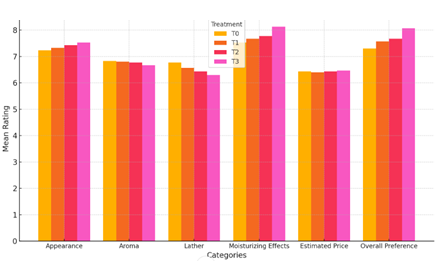
The increasing demand for natural and eco-friendly personal care products has spurred research into plant-based ingredients for the formulation of handmade soaps. This study investigates the development and characterization of mulberry-moringa handmade soap, combining the antioxidant-rich properties of mulberry (Morus sp.) and moringa (Moringa oleifera) leaves. The soap is assessed for its physico-chemical properties (pH, moisture content, foam height and foam stability) and consumer acceptability (appearance, aroma, lather, moisturizing effects, estimated price & overall preference). The findings suggest that the mulberry-moringa handmade soap exhibits promising skin nourishing properties, making it a viable candidate for the natural soap market.
Downloads
References
Ainie, K., Hamirin, K., & Peang-Kean, L. (1996). Assessment of the physicochemical properties of selected commercial soaps manufactured and sold in Kenya. Journal of American Oil Chemistry Society, 73(1), 105-108.
Arasaretnam, J., & Venujah K. (2019). Preparation of soaps by using different oils and analysis of their properties. Department of Chemistry, Eastern University, Chenkalady, Sri Lanka.
Bistline, R. (1996). Anionic and related lime soap dispersants in anionic surfactants: Organic Chemistry. CRC Press.
Chatterjee, A., & Pakrashi, S. (1994). The treatise on Indian medicinal plants. Publications and Directorate.
Girgis. A. (2003). Physical and chemical characteristics of toilet soap made from apricot kernel oil and palm stearin. Grasasy Aceites, 54(3), 226–233.
Islamiati Fitri, Windayani Neneng, & Rahmawati Sunarya, Risa. (2023). The making of an herbal paper soap from virgin coconut oil with addition of whey kefir. AIP Conference Proceedings. doi:10.1063/5.0119110.
Kaoru T. (1998). Surface activity: Principles, phenomena and application. San Diego: Academic Press.
Kareru, P., Keriko, J., Kenji, G., Thiong’o, G., Gachanja, A., & Mukiira, H. (2010). Antimicrobial activities of skincare preparations from plant extracts. African Journal of Traditional, Complementary and Alternative Medicines, 7(3), 43-56.
Konkol, K., & Rasmussen, S. (2015). An ancient cleanser: Soap production and use in antiquity. ACS Symposium Series, 12(11), 245–266.
Meléndez, P., & Capriles, V. (2006). Antibacterial properties of tropical plants from Puerto Rico. Phytomedicine, 13(4), 272–276.
Prieto, V. (2018). The effects of cold saponification on the unsaponified fatty acid composition and sensory perception of commercial natural herbal soaps. Molecules, 23(9), 86-101.
Ribeiro, A., Estanqueiro, M., Oliveira, M., & Lobo, J. (2015). Main benefits and applicability of plant extracts in skin care products. Cosmetics, 2(2), 48–65.
Shah, M., Natarajan, S., & Gousuddin, M. (2014). Formulation, evaluation and antibacterial efficiency of herbal hand wash gel. International Journal of Pharmacological Science, 25(2), 120-124.
Sindhu, R., Chitkara, M., Kaur, G., Kaur, A., Arora, S., & Sandhu, I. (2019). Formulation development and antimicrobial evaluation of polyherbal soap. Chitkara College of Pharmacy, Chitkara University.
Warra A., Wawata I., Gunu S., & Atiku, F. (2011). Soap preparation from Soxhlet extracted Nigerian Cotton seed oil. Advances in Applied Science Research, 2(5), 617–623.
Wijayawardhana Nirupama, Cooray Mmdu, Uluwaduge Deepthi, Arawwawala Ldam, & Jayasuriya W.J.A. Banukie. (2020). Development of a herbal soap using selected medicinal plants and evaluation of its antimicrobial activity. 13th International Research Conference, General Sir John Kotelawala Defense University, Sri Lanka.
Zauro, S. (2016). Production and analysis of soap using locally available raw materials. Accessed: Jan. 8, 2021. Available at: https://www.researchgate.net/publication/304782338
Published
How to Cite
Issue
Section
License
Copyright (c) 2025 Robelle M Tapado

This work is licensed under a Creative Commons Attribution 4.0 International License.


