Isolation and Evaluation of Aspergillus niger as Phosphofungi from Rhizosphere Soil of Medicinal Plant to Supplement Phospho-biofertilizer
DOI:
https://doi.org/10.31033/ABJAR/5.2.2026.116Keywords:
aspergillus niger, 18S rRNA sequence, organic acid, IAA, siderophoreAbstract
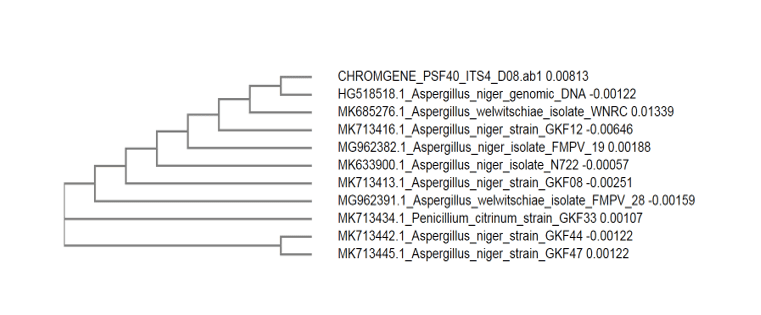
In the present study, the phosphate-solubilizing fungus was isolated and identified as Aspergillus niger. Its 18S rRNA gene sequence was deposited at GenBank, NCBI (MN904862). For the study of the Phosphate solubilization capacity of the fungus, different rhizosphere soil samples were collected from medicinal plants. 40 fungal colonies were isolated after serial dilution and one fungal colony with high phosphate solubilization zone was selected and further tested. The fungus showed good results in different phosphate solubilization tests, SI (3.91), SE (290), and pH of the culture filtrate after the growth of the fungus decreased from 6.89 to 3.13 due to the production of organic acids. The colour changed from blue to yellow on the agar plate and red to yellow in the broth due to the acidic condition of the media during the growth of the fungus. Titrable acidity was measured at 32.8g/L and 420µg of P was estimated in culture broth by the Vanadomolybdate method. The fungus showed a positive result for siderophore production. 20µg of Indole Acetic Acid (IAA) was produced by the fungus and was estimated by the Salkowaski reagent method using a standard calibration curve. Due to the phosphate solubilization capacity and production of plant growth promoters of A. niger, can be recommended as a Phosphate solubilizer in an agricultural field.
Downloads
References
Alam S, Khalil S, Ayub N, & Rashid M. (2002). In vitro solubilization of inorganic phosphate by phosphate solubilizing fungi (PSF) from maize rhizosphere. International Journal of Agriculture and Biology, 4(4), 454–458.
Aneja KR. (2007). Experiments in microbiology, plant pathology and biotechnology. New Dehli: New age International Publisher, pp. 157–162.
Antarikanonda P, Sassanarakit S, Amaret P, & Waiamai. (1991). Biological system for improving availability of rock phosphate to plant. in: Kinoshita, S. and Bhumiratana, A. (eds.), 612–19, Songkla, Thailand and Singapore.
Barnett HL. (1975). Illustrated genera of imperfect fungi, 2, 1–225.
Booth C. (1971). Illustrated the genus Fusarium. Common Wealth Mycological Institute, pp. 1–237.
Chandha N, Prasad R, & Varma A. (2015). Plant promoting activity of fungal endophytes associated with Tomato roots from central Himalaya, India and their interaction with Piriformspora indica. International Journal of Pharma and Bio Sciences, 6(1), 333–343.
Chatli AS, Beri V, & Sidhu BS. (2008). Isolation and characterization of phosphate solubilizing microorganisms from the cold desert habitat of Salix alba Linn. in trans Himalayan region of Himachal Pradesh. Indian Journal of Microbiology, 48, 267–273.
Elias F, Woyessa D, & Muleta D. (2016). Phosphate solubilization potential of rhizosphere fungi isolated from plants in Jimma zone, Southwest Ethiopia. International Journal of Microbiology, Article ID 5472601, 1-11.
Ghosh S, Banerjee S, & Sengupta C. (2017). Bioassay, characterization and estimation of siderophores from some important antagonistic fungi. Journal of Biopesticides, 10(2), 105–112.
Hamdali H, Hafidi M, Virolle MJ, & Ouhdouch Y. (2008). Rock phosphate solubilizing Actinimycetes: Screening for plant growth promoting activities. World Journal of Microbiology and Biotechnology, 24, 2565–2575.
Jain P, & Singh D. (2015). Study on the role of phosphate solubilising fungi in phosphorus bioavailability and growth enhancement of potato. Chemical Science Review and Letters, 4(13), 101–108.
Joseph S, & Jisha MS. (2008). Buffering reduces phosphate solubilizing ability of selected strains of bacteria. American-Eurasian Journal of Agricultural and Environmental Science, 4(1), 110-112.
KarunaiSelvi B, John Paul JA, Ravindran AD, & Vijaya V. (2011). Quantitative estimation of insoluble inorganic phosphate solubilization. International Journal of Science and Nature, 2(2), 292-295.
Khan R, & Gupta AK. (2015). Screening and optimization of organic acid producers from mine areas of Chhattisgarh region, India. International Journal of Current Microbiology and Applied Science, 4(2), 103-111.
Kotasthane AS, Agrawal T, Zaidi NW, & Singh US. (2017). Identification of siderophore producing and cynogenic fluorescent Pseudomonas and a simple confrontation assay to identify potential bio-control agent for collar rot of chickpea. Biotechnology, 7, 137.
Lipping Y, Jiatao X, Daohong J, Yanping F, Guoqing L, & Fangcan L. (2008). Antifungal substances produced by Penicillium oxalicum strain PY-1-potential antibiotics against plant pathogenic fungi. World Journal of Microbiology and Biotechnology, 24, 909–915.
Mahamuni SV, Wani PV, & Patil AS. (2012). Isolation of phosphate solubilizing fungi from rhizosphere of sugarcane & sugar beet using TCP & RP solubilization. Asian Journal of Biochemical and Pharmaceutical Research, 1(2), 237–244.
Mittal V, Singh O, Nayyar H, Kaur J, & Tewari R. (2008). Stimulatory effect of phosphate solubilizing fungal strains (Aspergillus awamori and Penicillium citrinum) on the yield of Chickpea (Cicer arietinum L. cv. GPF2). Soil Biology and Biochemistry, 40, 718-727.
Naik SK, Maurya S, Kumar R, Sadhna K, Gagrai S, Das B, Kumar S, & Bhatt BP. (2013). Inorganic phosphate solubilization by phosphate solubilizing fungi isolated from acidic soils, African Journal of Microbiology Research, 7(34), 4310–4316.
Nenwani V, Doshi P, Saha T, & Shalini R. (2010). Isolation and characterization of a fungal isolate for phosphate solubilization and plant growth promoting activity. Journal of Yeast and Fungal Research, 1(1), 009–014.
Nisha K, Padma Devi SN, Vasandha S, & Sunitha Kumari K. (2014). Role of phosphorous solubilizing microorganisms to eradicate p- deficiency in plants: A review. International Journal of Scientific and Research Publications, 4(7), 1–5.
Omar SA. (1998). The role of rock Phosphate Solubilising fungi and Vesicular Arbuscular Mycorrhiza (VAM) in growth of wheat plants fertilized with rock phosphate. World Journal of Microbiology and Biotechnology, 14(21), 1–8.
Pant G, & Agrawal PK. (2014). Isolation and characterisation of indole acetic acid producing plant growth promoting rhizobacteria from rhizospheric soil of Withania somnefera. Journal of Biological and Scientific Opinion, 2(6), 377–383.
Sahoo HR, & Gupta N. (2014). Evaluation of phosphate solubilizing potential of some endophytic fungi under solid and liquid state. BMR Microbiology, 1(1), 1–6.
Sharma AK. (2007). Biofertilizers for sustainable agriculture. (1st ed.). India: AGROBIOS, pp. 194–200.
Stephen J, & Jisha MS. (2011). Gluconic acid production as the principal mechanism of mineral phosphate solubilization by Burkholderia sp. (MTCC 8369). Journal of Tropical Agriculture, 49(1-2), 99-103.
Subramanian CV. (1983). Hyphomycetes taxonomy and biology. London: Academic Press, Vol. I and II, pp. 1-930.
Verma A, & Ekka A. (2015). Assessment of phosphate solubilizing potential of fungal isolates from soils of three blocks of Raipur, Chhattisgarh, India. Journal of Ravishankar University-B, 28(2), 44–50.
Walpola BC, & Yoon Min-Ho. (2012). Prospectus of phosphate Solubilizing microorganisms and phosphorus availability in agricultural soils: A review. African Journal of Microbiology Research, 6(37), 6600–6605.
Wani PA, Khan MS, & Zaidi A. (2007b). Synergistic effects of the inoculation with nitrogen fixing and phosphate solubilizing rhizobacteria on the performance of field grown chickpea. Journal of Plant Nutrition and Soil Science, 170, 283–287.
Yasser MM, Ahmad S, Mousa M, Massoud ON, & Nasr SH. (2014). Solubilization of inorganic phosphate by phosphate solubilizing fungi isolated from Egyptian soils. Journal of Biology and Earth Sciences, 14(4), B83-B90.
Published
How to Cite
Issue
Section
License
Copyright (c) 2026 Jyothi, V, Vijayalakshmi, V, Nandish, G, Thippeswamy, B

This work is licensed under a Creative Commons Attribution 4.0 International License.


