Dose-dependent Effects of Ethanol on Caudal Fin Regeneration in Zebrafish (Danio rerio)
DOI:
https://doi.org/10.31033/ABJAR/5.3.2026.118Keywords:
zebrafish (Danio rerio), caudal fin regeneration, ethanol toxicity, dose-dependency, regenerative biology, teratogenAbstract
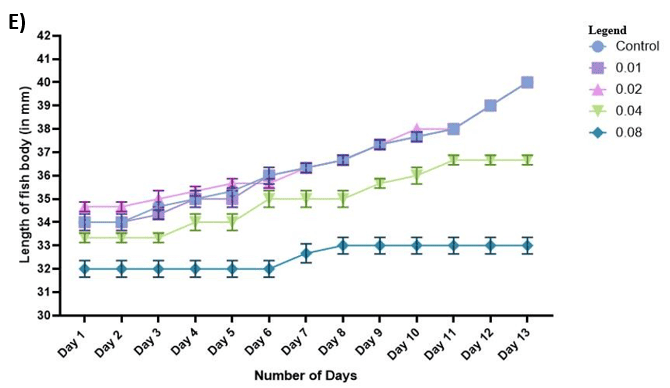
Ethanol is a well-established teratogen known to disrupt developmental signalling pathways; however, its effects on adult tissue regeneration remain insufficiently understood. This study investigates the dose-dependent impact of ethanol on the regenerative capacity of the caudal fin in adult zebrafish (Danio rerio). Adult zebrafish (mean body length ~40 mm) underwent caudal fin amputation and were subsequently exposed to sub-lethal ethanol concentrations of 0.01%, 0.02%, 0.04%, and 0.08% (v/v), alongside a control group. The fish were maintained under these conditions and monitored daily until complete regeneration was observed in the control group.
The results demonstrate a clear concentration-dependent effect of ethanol on regeneration. Lower ethanol concentrations exhibited regeneration patterns comparable to the control, whereas higher concentrations resulted in delayed and markedly reduced fin regrowth. These findings suggest that elevated ethanol exposure may interfere with oxidative balance and key morphogenetic signalling pathways essential for wound healing and tissue regeneration.
This study provides foundational insights into the influence of environmental toxicants on regenerative processes and highlights the need for further mechanistic investigations.
Downloads
References
Akimenko, M. A., Marí-Beffa, M., Becerra, J., & Géraudie, J. (2003). Old questions, new tools, and some answers to the mystery of fin regeneration. Developmental Dynamics, 226(2), 190–201. https://doi.org/10.1002/DVDY.10248
Alibardi, L. (2022). Invited letter. Organ regeneration occurs in vertebrates with aquatic-related life cycles including metamorphosis and was lost during land transition. Integrative and Comparative Biology, 62(1), 121–123. https://doi.org/10.1093/ICB/ICAC004
Alsakran, A., & Kudoh, T. (2021). Zebrafish as a model for fetal alcohol spectrum disorders. Frontiers in Pharmacology, 12, 721924. https://doi.org/10.3389/FPHAR.2021.721924/BIBTEX
Azevedo, A. S., Grotek, B., Jacinto, A., Weidinger, G., & Saúde, L. (2011). The regenerative capacity of the zebrafish caudal fin is not affected by repeated amputations. PLoS ONE, 6(7). https://doi.org/10.1371/JOURNAL.PONE.0022820,
Beffagna, G. (2019). Zebrafish as a smart model to understand regeneration after heart injury: How fish could help humans. Frontiers in Cardiovascular Medicine, 6, 107. https://doi.org/10.3389/FCVM.2019.00107
Bilotta, J., Barnett, J. A., Hancock, L., & Saszik, S. (2004). Ethanol exposure alters zebrafish development: A novel model of fetal alcohol syndrome. Neurotoxicology and Teratology, 26(6 SPEC. ISS.), 737–743. https://doi.org/10.1016/j.ntt.2004.06.011
Cao, Z., Guo, C., Chen, G., Liu, J., Ni, H., Liu, F., Xiong, G., Liao, X., & Lu, H. (2022). Shikonin inhibits fin regeneration in zebrafish larvae. Cells, 11(20). https://doi.org/10.3390/CELLS11203187,
Coffey, E. C., Pasquarella, M. E., Goody, M. F., & Henry, C. A. (2018). Ethanol exposure causes muscle degeneration in zebrafish. Journal of Developmental Biology, 6(1), 7. https://doi.org/10.3390/JDB6010007
Gamba, L., Harrison, M., & Lien, C. L. (2014). Cardiac regeneration in model organisms topical collection on regenerative medicine and stem-cell therapy. Current Treatment Options in Cardiovascular Medicine, 16(3). https://doi.org/10.1007/S11936-013-0288-8
Gemberling, M., Bailey, T. J., Hyde, D. R., & Poss, K. D. (2013). The zebrafish as a model for complex tissue regeneration. Trends in Genetics, 29(11), 611–620. https://doi.org/10.1016/J.TIG.2013.07.003
Heaton, M. B., Paiva, M., Mayer, J., & Miller, R. (2002). Ethanol-mediated generation of reactive oxygen species in developing rat cerebellum. Neuroscience Letters, 334(2), 83–86. https://doi.org/10.1016/S0304-3940(02)01123-0
Kizil, C., Kaslin, J., Kroehne, V., & Brand, M. (2012). Adult neurogenesis and brain regeneration in zebrafish. Wiley Online Library, 72(3), 429–461. https://doi.org/10.1002/DNEU.20918
Knopf, F., Hammond, C., Chekuru, A., Kurth, T., Hans, S., Weber, C. W., Mahatma, G., Fisher, S., Brand, M., Schulte-Merker, S., & Weidinger, G. (2011). Bone regenerates via dedifferentiation of osteoblasts in the zebrafish fin. Developmental Cell, 20(5), 713–724. https://doi.org/10.1016/J.DEVCEL.2011.04.014,
Kudoh, T., Wilson, S. W., & Dawid, I. B. (2002). Distinct roles for Fgf, Wnt and retinoic acid in posteriorizing the neural ectoderm. Development, 129(18), 4335–4346. https://doi.org/10.1242/DEV.129.18.4335
Lee, H. J., Hou, Y., Chen, Y., Dailey, Z. Z., Riddihough, A., Jang, H. S., Wang, T., & Johnson, S. L. (2020). Regenerating zebrafish fin epigenome is characterized by stable lineage-specific DNA methylation and dynamic chromatin accessibility. Genome Biology, 21(1), 1–17. https://doi.org/10.1186/S13059-020-1948-0/FIGURES/4
Lenkowski, J. R., Qin, Z., Sifuentes, C. J., Thummel, R., Soto, C. M., Moens, C. B., & Raymond, P. A. (2013). Retinal regeneration in adult zebrafish requires regulation of TGFβ signaling. Wiley Online Library, 61(10), 1687–1697. https://doi.org/10.1002/GLIA.22549
Liu, Y., Lou, W. P. K., & Fei, J. F. (2021). The engine initiating tissue regeneration: does a common mechanism exist during evolution? Cell Regeneration, 10(1), 1–12. https://doi.org/10.1186/S13619-020-00073-1
Mahmood, R., Bresnick, J., Hornbruch, A., Mahony, C., Morton, N., Colquhoun, K., Martin, P., Lumsden, A., Dickson, C., & Mason, I. (1995). A role for FGF-8 in the initiation and maintenance of vertebrate limb bud outgrowth. Current Biology, 5(7), 797– 806. https://doi.org/10.1016/S0960-9822(95)00157-6
Marques, I. J., Lupi, E., & Mercader, N. (2019). Model systems for regeneration: Zebrafish. Development (Cambridge), 146(18). https://doi.org/10.1242/DEV.167692,
Mateus, R., Pereira, T., Sousa, S., de Lima, J. E., Pascoal, S., Saúde, L., & Jacinto, A. (2012). In vivo cell and tissue dynamics underlying zebrafish fin fold regeneration. PLOS ONE, 7(12), e51766. https://doi.org/10.1371/JOURNAL.PONE.0051766
Petrie, T. A., Strand, N. S., Tsung-Yang, C., Rabinowitz, J. S., & Moon, R. T. (2014). Macrophages modulate adult zebrafish tail fin regeneration. Development (Cambridge), 141(13), 2581–2591. https://doi.org/10.1242/DEV.098459,
Pfefferli, C., Müller, F., Jaźwińska, A., & Wicky, C. (2014). Specific NuRD components are required for fin regeneration in zebrafish. BMC Biology, 12(1), 1–17. https://doi.org/10.1186/1741-7007-12-30/FIGURES/8
Pinheiro-da-Silva, J., & Luchiari, A. C. (2021). Embryonic ethanol exposure on zebrafish early development. Brain and Behavior, 11(6). https://doi.org/10.1002/brb3.2062
Poss, K. D., Shen, J., Nechiporuk, A., McMahon, G., Thisse, B., Thisse, C., & Keating, M.
T. (2000). Roles for Fgf signaling during zebrafish fin regeneration. Developmental Biology, 222(2), 347–358. https://doi.org/10.1006/dbio.2000.9722
Ray, P. D., Huang, B. W., & Tsuji, Y. (2012). Reactive oxygen species (ROS) homeostasis and redox regulation in cellular signaling. Cellular Signalling, 24(5), 981–990. https://doi.org/10.1016/j.cellsig.2012.01.008
Romero, M. M. G., McCathie, G., Jankun, P., & Roehl, H. H. (2018). Damage-induced reactive oxygen species enable zebrafish tail regeneration by repositioning of Hedgehog expressing cells. Nature Communications, 9(1), 4010. https://doi.org/10.1038/S41467-018- 06460-2
Saputra, F., Kishida, M., & Hu, S. Y. (2024). Oxidative stress induced by hydrogen peroxide disrupts zebrafish visual development by altering apoptosis, antioxidant and estrogen related genes. Scientific Reports, 14(1), 1–14. https://doi.org/10.1038/S41598- 024-64933
Sehring, I. M., & Weidinger, G. (2020). Recent advancements in understanding fin regeneration in zebrafish. Wiley Interdisciplinary Reviews: Developmental Biology, 9(1). https://doi.org/10.1002/WDEV.367,
Sehring, I., & Weidinger, G. (2022a). Zebrafish fin: Complex molecular interactions and cellular mechanisms guiding regeneration. Cold Spring Harbor Perspectives in Biology, 14(7). https://doi.org/10.1101/CSHPERSPECT.A040758,
Shao, J., Chen, D., Ye, Q., Cui, J., Li, Y., & Li, L. (2011). Tissue regeneration after injury in adult zebrafish: The regenerative potential of the caudal fin. Developmental Dynamics, 240(5), 1271–1277. https://doi.org/10.1002/DVDY.22603,
Sidik, A., Dixon, G., Buckley, D. M., Kirby, H. G., Sun, S., & Eberhart, J. K. (2021). Exposure to ethanol leads to midfacial hypoplasia in a zebrafish model of FASD via indirect interactions with the Shh pathway. BMC Biology, 19(1), 1–18. https://doi.org/10.1186/S12915-021-01062-9/FIGURES/7
Smith, A. M., Zeve, D. R., Grisel, J. J., & Chen, W. J. A. (2005). Neonatal alcohol exposure increases malondialdehyde (MDA) and glutathione (GSH) levels in the developing cerebellum. Developmental Brain Research, 160(2), 231–238. https://doi.org/10.1016/j.devbrainres.2005.09.004
Soares, A. R., Pereira, P. M., Ferreira, V., Reverendo, M., Simóes, J., Bezerra, A. R., Moura, G. R., & Santos, M. A. S. (2014). Ethanol Exposure Induces Upregulation of Specific MicroRNAs in Zebrafish Embryos. Toxicological Sciences, 127(1), 18–28. https://doi.org/10.1093/TOXSCI/KFS068
Sousa, S., Afonso, N., Bensimon-Brito, A., Fonseca, M., Simões, M., Leon, J., Roehl, H., Cancela, M. L., & Jacinto, A. (2011). Differentiated skeletal cells contribute to blastema formation during zebrafish fin regeneration. Development, 138(18), 3897–3905. https://doi.org/10.1242/DEV.064717,
Surette, E., Donahue, J., Robinson, S., McKenna, D., Martinez, C. S., Fitzgerald, B., Karlstrom, R. O., Cumplido, N., & McMenamin, S. K. (2024). Adult caudal fin shape is imprinted in the embryonic fin fold. BioRxiv, 2024.07.16.603744. https://doi.org/10.1101/2024.07.16.603744
Tang, D., He, Y., Li, W., & Li, H. (2019). Wnt/β-catenin interacts with the FGF pathway to promote proliferation and regenerative cell proliferation in the zebrafish lateral line neuromast. Experimental & Molecular Medicine, 51(5), 1–16. https://doi.org/10.1038/s12276-019-0247-x
Tsedensodnom, O., Vacaru, A. M., Howarth, D. L., Yin, C., & Sadler, K. C. (2013). Ethanol metabolism and oxidative stress are required for unfolded protein response activation and steatosis in zebrafish with alcoholic liver disease. DMM Disease Models and Mechanisms, 6(5), 1213–1226. https://doi.org/10.1242/DMM.012195/-/DC1
Uemoto, T., Abe, G., & Tamura, K. (2020). Regrowth of zebrafish caudal fin regeneration is determined by the amputated length. Scientific Reports, 10(1), 649. https://doi.org/10.1038/S41598-020-57533-6
Voordeckers, K., Colding, C., Grasso, L., Pardo, B., Hoes, L., Kominek, J., Gielens, K., Dekoster, K., Gordon, J., Van der Zande, E., Bircham, P., Swings, T., Michiels, J., Van Loo, P., Nuyts, S., Pasero, P., Lisby, M., & Verstrepen, K. J. (2020). Ethanol exposure increases mutation rate through error-prone polymerases. Nature Communications, 11(1), 1–16. https://doi.org/10.1038/s41467-020-17447-3
Wehner, D., & Weidinger, G. (2015). Signaling networks organizing regenerative growth of the zebrafish fin. Trends in Genetics, 31(6), 336–343. https://doi.org/10.1016/J.TIG.2015.03.012/ASSET/1D83B629-4414-4A2F-B01D- C503538DE073/MAIN.ASSETS/GR4.SML
Wu, Z., Chen, S. Y., & Zheng, L. (2024). Sulforaphane Attenuates Ethanol-Induced Teratogenesis and Dysangiogenesis in Zebrafish Embryos. International Journal of Molecular Sciences, 25(21), 11529. https://doi.org/10.3390/IJMS252111529
Published
How to Cite
Issue
Section
License
Copyright (c) 2026 Soni Ghumnani, Tanishka Shirke, Alana Sherin Shaikh, Amruta Gokhale, Sweta Yadav, Shruti Yadav, Vishal Kadu

This work is licensed under a Creative Commons Attribution 4.0 International License.


