Bridging Biology and Artificial Intelligence: Opportunities, Tools, Challenges, and Ethical Considerations
DOI:
https://doi.org/10.31033/ABJAR/5.3.2026.121Keywords:
artificial intelligence, machine learning, deep learning, genomics, protein structure, drug discovery, ecology, bioethicsAbstract
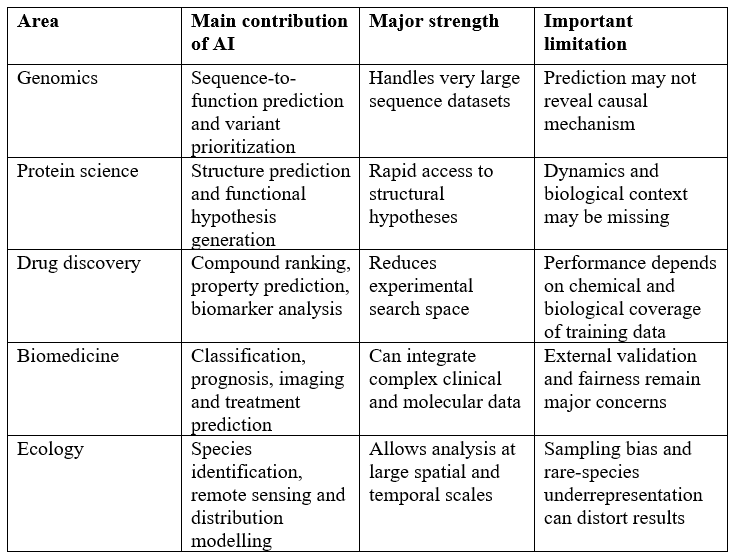
Artificial intelligence (AI) is now widely used in biological research. It helps researchers analyse large datasets, identify patterns, and make predictions that are difficult to obtain by manual analysis alone. In genomics, AI can relate DNA sequence to gene regulation and variant effects. In structural biology, deep-learning systems such as AlphaFold have greatly improved protein-structure prediction. AI is also being used in drug discovery, medical data analysis, ecology, and biodiversity monitoring. These advances are important, but they do not remove the need for biological reasoning or experimental validation. Model performance depends strongly on the quality and diversity of training data, while many high-performing models remain difficult to interpret. The use of genomic and clinical data also raises concerns about privacy, fairness, accountability, and unequal access to computational resources. This review examines major applications of AI in biology, summarizes the main computational approaches, and compares their strengths and limitations. It also considers ethical issues and identifies areas where human judgement remains essential. AI is most useful when it supports, rather than replaces, biological expertise, careful experimental design, and transparent scientific decision-making.
Downloads
References
Char, D. S., Shah, N. H., & Magnus, D. (2018). Implementing machine learning in health care—Addressing ethical challenges. New England Journal of Medicine, 378(11), 981–983. https://doi.org/10.1056/NEJMp1714229
Ching, T., Himmelstein, D. S., Beaulieu-Jones, B. K., Kalinin, A. A., Do, B. T., Way, G. P., Ferrero, E., Agapow, P.-M., Zietz, M., Hoffman, M. M., Xie, W., Rosen, G. L., Lengerich, B. J., Israeli, J., Lanchantin, J., Woloszynek, S., Carpenter, A. E., Shrikumar, A., Xu, J., ... Greene, C. S. (2018). Opportunities and obstacles for deep learning in biology and medicine. Journal of the Royal Society Interface, 15(141), Article 20170387. https://doi.org/10.1098/rsif.2017.0387
Christin, S., Hervet, É., & Lecomte, N. (2019). Applications for deep learning in ecology. Methods in Ecology and Evolution, 10(10), 1632–1644. https://doi.org/10.1111/2041-210X.13256
Eraslan, G., Avsec, Ž., Gagneur, J., & Theis, F. J. (2019). Deep learning: New computational modelling techniques for genomics. Nature Reviews Genetics, 20(7), 389–403. https://doi.org/10.1038/s41576-019-0122-6
Jumper, J., Evans, R., Pritzel, A., Green, T., Figurnov, M., Ronneberger, O., Tunyasuvunakool, K., Bates, R., Žídek, A., Potapenko, A., Bridgland, A., Meyer, C., Kohl, S. A. A., Ballard, A. J., Cowie, A., Romera-Paredes, B., Nikolov, S., Jain, R., Adler, J., ... Hassabis, D. (2021). Highly accurate protein structure prediction with AlphaFold. Nature, 596(7873), 583–589. https://doi.org/10.1038/s41586-021-03819-2
Obermeyer, Z., Powers, B., Vogeli, C., & Mullainathan, S. (2019). Dissecting racial bias in an algorithm used to manage the health of populations. Science, 366(6464), 447–453. https://doi.org/10.1126/science.aax2342
Vamathevan, J., Clark, D., Czodrowski, P., Dunham, I., Ferran, E., Lee, G., Li, B., Madabhushi, A., Shah, P., Spitzer, M., & Zhao, S. (2019). Applications of machine learning in drug discovery and development. Nature Reviews Drug Discovery, 18(6), 463–477. https://doi.org/10.1038/s41573-019-0024-5
Published
How to Cite
Issue
Section
License
Copyright (c) 2026 Everest Shiwach, Sandeep Kumar

This work is licensed under a Creative Commons Attribution 4.0 International License.
Research Articles in 'Applied Science and Biotechnology Journal for Advanced Research' are Open Access articles published under the Creative Commons CC BY License Creative Commons Attribution 4.0 International License http://creativecommons.org/licenses/by/4.0/. This license allows you to share – copy and redistribute the material in any medium or format. Adapt – remix, transform, and build upon the material for any purpose, even commercially.


