Weeds as Wealth: An Ethnobotanical and Phytochemical Review of Medicinally Important Weeds and their Therapeutic Relevance to Human Health
DOI:
https://doi.org/10.31033/ABJAR/5.2.2026.124Keywords:
ethnobotany, phytochemicals, traditional medicine, drug discovery, human health, toxicity, medicinal plants, weedsAbstract
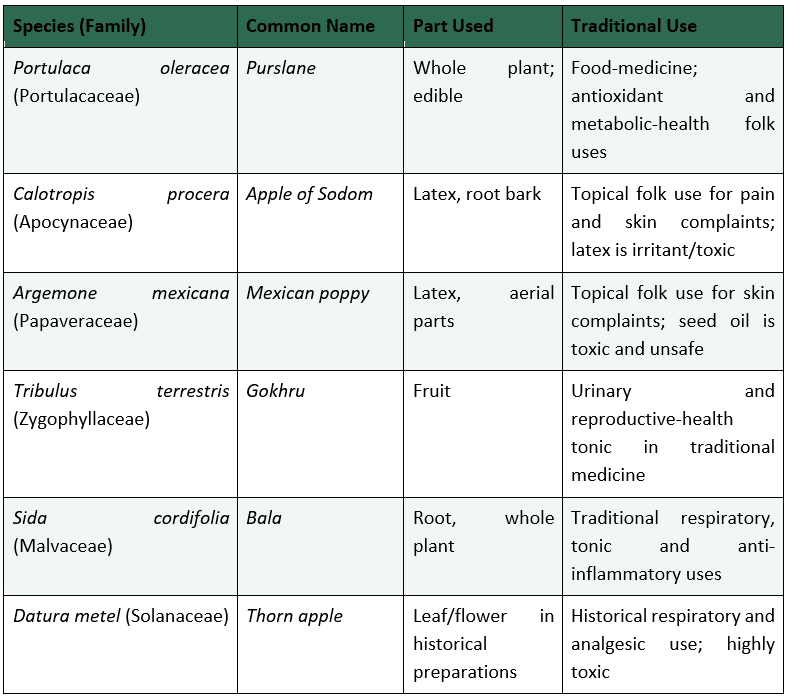
Generally, common men treat weeds as obnoxious plants, but most of the weeds have phytochemicals having different types of therapeutic applications. In this review, we have assessed the ethnobotanical utility, major phytochemicals, pharmacological proof and safety concerns of fifteen medicinal weeds representing thirteen plant families. These species contain various groups of constituents, such as coumestans, lignans, flavonoids, saponins, sesquiterpenes, steroidal glycoalkaloids, cardenolides and several classes of alkaloids. Different investigations support a range of biological activities pertinent to liver, urinary, respiratory, wound-healing and metabolic disorders. Most of the evidence is not consistent and remains predominantly preclinical for most of the species. Most of the literature we have is of traditional knowledge, and traditional use cannot be interpreted as proof of efficacy or safety. Direct clinical evidence is very limited. A few weeds such as Datura, Argemone and Calotropis contain several chemicals, which can be toxic to human beings. If we successfully authenticate them botanically, standardize the extracts, implement marker-based quality control, evaluate their toxic components, and conduct well-designed clinical studies, then these weeds will be the future of medicine and easily accessible bioresources for ethnopharmacological research.
Downloads
References
Stepp JR, & Moerman DE. (2001). The importance of weeds in ethnopharmacology. J Ethnopharmacol, 75(1), 19-23. doi:10.1016/S0378-8741(00)00385-8.
Stepp JR. (2004). The role of weeds as sources of pharmaceuticals. J Ethnopharmacol, 92(2-3), 163-166. doi:10.1016/j.jep.2004.03.002.
Fabricant DS, & Farnsworth NR. (2001). The value of plants used in traditional medicine for drug discovery. Environ Health Perspect, 109(Suppl 1), 69-75. doi:10.1289/ehp.01109s169.
Nasim N, Sandeep IS, & Mohanty S. (2022). Plant-derived natural products for drug discovery: current approaches and prospects. Nucleus, 65(3), 399-411. doi:10.1007/s13237-022-00405-3.
Timalsina D, & Devkota HP. (2021). Eclipta prostrata (L.) L. (Asteraceae): ethnomedicinal uses, chemical constituents, and biological activities. Biomolecules, 11(11), 1738. doi:10.3390/biom11111738.
Mishra S, Aeri V, Gaur PK, & Jachak SM. (2014). Phytochemical, therapeutic, and ethnopharmacological overview for a traditionally important herb: Boerhavia diffusa Linn. Biomed Res Int., 808302. doi:10.1155/2014/808302.
Dhawan S, & Olweny EO. (2020). Phyllanthus niruri (stone breaker) herbal therapy for kidney stones: A systematic review and meta-analysis of clinical efficacy, and Google Trends analysis of public interest. Can J Urol., 27(2), 10162-10166.
He X, Wang X, Fang J, Chang Y, Ning N, Guo H, Huang L, & Huang X. (2017). The genus Achyranthes: A review on traditional uses, phytochemistry, and pharmacological activities. J Ethnopharmacol, 203, 260-278. doi:10.1016/j.jep.2017.03.035.
Yaduvanshi B, Mathur R, Mathur SR, & Velpandian T. (2011). Evaluation of wound healing potential of topical formulation of leaf juice of Tridax procumbens L. in mice. Indian J Pharm Sci., 73(3), 303-306. doi:10.4103/0250-474X.93523.
Kumar S, Malhotra R, & Kumar D. (2010). Euphorbia hirta: Its chemistry, traditional and medicinal uses, and pharmacological activities. Pharmacogn Rev., 4(7), 58-61. doi:10.4103/0973-7847.65327.
Biswas TK, Pandit S, Chakrabarti S, Banerjee S, Poyra N, & Seal T. (2017). Evaluation of Cynodon dactylon for wound healing activity. J Ethnopharmacol, 97, 128-137. doi:10.1016/j.jep.2016.07.065.
Pirzada AM, Ali HH, Naeem M, Latif M, Bukhari AH, & Tanveer A. (2015). Cyperus rotundus L.: Traditional uses, phytochemistry, and pharmacological activities. J Ethnopharmacol, 174, 540-560. doi:10.1016/j.jep.2015.08.012.
Chen X, Dai X, Liu Y, Yang Y, Yuan L, He X, & Gong G. (2022). Solanum nigrum Linn.: an insight into current research on traditional uses, phytochemistry, and pharmacology. Front Pharmacol.,13, 918071. doi:10.3389/fphar.2022.918071.
Zhou YX, Xin HL, Rahman K, Wang SJ, Peng C, & Zhang H. (2015). Portulaca oleracea L.: A review of phytochemistry and pharmacological effects. Biomed Res Int., 2015, 925631. doi:10.1155/2015/925631.
Wadhwani BD, Mali D, Vyas P, Nair R, & Khandelwal P. (2021). A review on phytochemical constituents and pharmacological potential of Calotropis procera. RSC Adv., 11(57), 35854-35878. doi:10.1039/D1RA06703F.
Patocka J, Ovando-Martinez M, Navratilova Z, Oleksak P, Ogwu MC, Nepovimova E, & Kuca K. (2024). Argemone mexicana L. (Papaveraceae): chemistry, pharmacology, and toxicology. Phytochem Rev., 23(4), 1167-1182. doi:10.1007/s11101-024-09918-y.
Zhu W, Du Y, Meng H, Dong Y, & Li L. (2017). A review of traditional pharmacological uses, phytochemistry, and pharmacological activities of Tribulus terrestris. Chem Cent J., 11, 60. doi:10.1186/s13065-017-0289-x.
Dinda B, Das N, Dinda S, Dinda M, & SilSarma I. (2015). The genus Sida L. - a traditional medicine: its ethnopharmacological, phytochemical and pharmacological data for commercial exploitation in herbal drugs industry. J Ethnopharmacol, 176, 135-176. doi:10.1016/j.jep.2015.10.027.
Islam T, Ara I, Islam MT, Sah PK, & de Almeida RS, et al. (2023). Ethnobotanical uses and phytochemical, biological, and toxicological profiles of Datura metel L.: A review. Curr Res Toxicol., 4, 100106. doi:10.1016/j.crtox.2023.100106.
Sharma M, Dhaliwal I, Rana K, Delta AK, & Kaushik P. (2021). Phytochemistry, pharmacology, and toxicology of Datura species - A review. Antioxidants. 10(8), 1291. doi:10.3390/antiox10081291.
Sharma T, Brahma B, Laskar AAM, & Paul J. (2023). Clinical profile and outcomes of epidemic dropsy patients attending a tertiary care centre in Assam, India. Cureus, 15(4), e37408. doi:10.7759/cureus.37408.
Iyadurai R, Gunasekaran K, Jose A, & Pitchaimuthu K. (2020). Calotropis poisoning with severe cardiac toxicity: A case report. J Family Med Prim Care, 9(8), 4444-4447. doi:10.4103/jfmpc.jfmpc_783_20.
Singh SK, Kesari AN, Gupta RK, Jaiswal D, & Watal G. (2007). Assessment of antidiabetic potential of Cynodon dactylon extract in streptozotocin diabetic rats. J Ethnopharmacol, 114(2), 174-179. doi:10.1016/j.jep.2007.07.039.
Published
How to Cite
Issue
Section
License
Copyright (c) 2026 Everest Shiwach, Sandeep Kumar

This work is licensed under a Creative Commons Attribution 4.0 International License.


