Biofertilizers and Biopesticides in Sustainable Agriculture: Mechanisms, Applications, Constraints, and Emerging Directions—A Review
DOI:
https://doi.org/10.31033/ABJAR/5.3.2026.125Keywords:
biofertilizers, biopesticides, sustainable agriculture, plant growth-promoting rhizobacteria, biological control, soil health, integrated pest management, microbial inoculantsAbstract
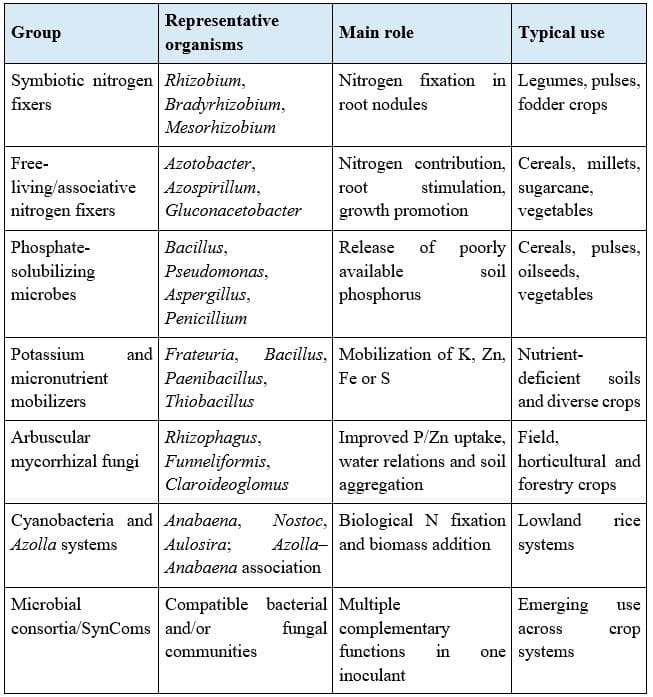
Modern agriculture needs high productivity, but it also needs healthy soil, clean water and safer pest management. Heavy and poorly managed use of synthetic fertilizers and chemical pesticides can disturb nutrient balance, increase pollution, leave residues and select resistant pest populations. Biofertilizers and biopesticides offer a different route. Biofertilizers use beneficial microorganisms to improve nutrient availability, root growth and plant tolerance to stress. Biopesticides use microorganisms, plant products, natural compounds or other biological agents to suppress insects, pathogens, nematodes and weeds. This review brings these two groups together and examines how they can support sustainable crop production. It discusses major biofertilizers such as rhizobia, Azotobacter, Azospirillum, phosphate- and potassium-solubilizing microorganisms, arbuscular mycorrhizal fungi, cyanobacteria and microbial consortia. It also reviews important biopesticides, including Bacillus thuringiensis, Trichoderma, Pseudomonas, Bacillus, entomopathogenic fungi, baculoviruses, entomopathogenic nematodes, neem products and pheromones. The strongest value of these inputs appears when farmers integrate them with balanced fertilization, organic matter management, resistant cultivars, crop rotation and integrated pest management rather than use them as isolated replacements. Field performance, however, remains variable. Shelf life, formulation quality, environmental sensitivity, product standards and farmer handling all matter. Research reported through December 2025 shows a clear shift toward synthetic microbial communities, microbiome-guided strain selection, multi-omics, improved fermentation, encapsulation, nano-enabled delivery and precision application. These advances are promising, but laboratory success must be matched by reproducible field evidence and strong biosafety assessment. Better products will come from locally adapted strains, transparent quality control and realistic recommendations for farmers.
Downloads
References
Alori, E. T., Glick, B. R., & Babalola, O. O. (2017). Microbial phosphorus solubilization and its potential for use in sustainable agriculture. Frontiers in Microbiology, 8, 971. https://doi.org/10.3389/fmicb.2017.00971
Ayilara, M. S., Adeleke, B. S., Akinola, S. A., Fayose, C. A., Adeyemi, U. T., Gbadegesin, L. A., Omole, R. K., Johnson, R. M., Uthman, Q. O., & Babalola, O. O. (2023). Biopesticides as a promising alternative to synthetic pesticides: A case for microbial pesticides, phytopesticides, and nanobiopesticides. Frontiers in Microbiology, 14, 1040901. https://doi.org/10.3389/fmicb.2023.1040901
Backer, R., Rokem, J. S., Ilangumaran, G., Lamont, J., Praslickova, D., Ricci, E., Subramanian, S., & Smith, D. L. (2018). Plant growth-promoting rhizobacteria: Context, mechanisms of action, and roadmap to commercialization of biostimulants for sustainable agriculture. Frontiers in Plant Science, 9, 1473. https://doi.org/10.3389/fpls.2018.01473
Bashan, Y., de-Bashan, L. E., Prabhu, S. R., & Hernandez, J.-P. (2014). Advances in plant growth-promoting bacterial inoculant technology: Formulations and practical perspectives, 1998–2013. Plant and Soil, 378, 1–33. https://doi.org/10.1007/s11104-013-1956-x
Begum, N., Qin, C., Ahanger, M. A., Raza, S., Khan, M. I., Ashraf, M., Ahmed, N., & Zhang, L. (2019). Role of arbuscular mycorrhizal fungi in plant growth regulation: Implications in abiotic stress tolerance. Frontiers in Plant Science, 10, 1068. https://doi.org/10.3389/fpls.2019.01068
Bhattacharyya, P. N., & Jha, D. K. (2012). Plant growth-promoting rhizobacteria (PGPR): Emergence in agriculture. World Journal of Microbiology and Biotechnology, 28(4), 1327–1350. https://doi.org/10.1007/s11274-011-0979-9
Bravo, A., Likitvivatanavong, S., Gill, S. S., & Soberón, M. (2011). Bacillus thuringiensis: A story of a successful bioinsecticide. Insect Biochemistry and Molecular Biology, 41(7), 423–431. https://doi.org/10.1016/j.ibmb.2011.02.006
Carpenter, S. R. (2008). Phosphorus control is critical to mitigating eutrophication. Proceedings of the National Academy of Sciences of the United States of America, 105(32), pp. 11039–11040. https://doi.org/10.1073/pnas.0806112105
Chandler, D., Bailey, A. S., Tatchell, G. M., Davidson, G., Greaves, J., & Grant, W. (2011). The development, regulation and use of biopesticides for integrated pest management. Philosophical Transactions of the Royal Society B: Biological Sciences, 366(1573), pp. 1987–1998. https://doi.org/10.1098/rstb.2010.0390
Cheng, Y., Narayanan, M., Shi, X., Chen, X., Li, Z., & Ma, Y. (2023). Phosphate-solubilizing bacteria: Their agroecological function and optimistic application for enhancing agro-productivity. Science of the Total Environment, 901, 166468. https://doi.org/10.1016/j.scitotenv.2023.166468
Delaeter, M., Magnin-Robert, M., Randoux, B., & Lounès-Hadj Sahraoui, A. (2024). Arbuscular mycorrhizal fungi as biostimulant and biocontrol agents: A review. Microorganisms, 12(7), 1281. https://doi.org/10.3390/microorganisms12071281
Díaz-Rodríguez, A. M., Parra Cota, F. I., Cira Chávez, L. A., García Ortega, L. F., Estrada Alvarado, M. I., Santoyo, G., & de Los Santos-Villalobos, S. (2025). Microbial inoculants in sustainable agriculture: Advancements, challenges, and future directions. Plants, 14(2), 191. https://doi.org/10.3390/plants14020191
Fadiji, A. E., Xiong, C., Egidi, E., & Singh, B. K. (2024). Formulation challenges associated with microbial biofertilizers in sustainable agriculture and paths forward. Journal of Sustainable Agriculture and Environment, 3(3), e70006. https://doi.org/10.1002/sae2.70006
Fenibo, E. O., & Matambo, T. (2025). Biopesticides for sustainable agriculture: Feasible options for adopting cost-effective strategies. Frontiers in Sustainable Food Systems, 9, 1657000. https://doi.org/10.3389/fsufs.2025.1657000
Fravel, D. R. (2005). Commercialization and implementation of biocontrol. Annual Review of Phytopathology, 43, 337–359. https://doi.org/10.1146/annurev.phyto.43.032904.092924
Galloway, J. N., Townsend, A. R., Erisman, J. W., Bekunda, M., Cai, Z., Freney, J. R., Martinelli, L. A., Seitzinger, S. P., & Sutton, M. A. (2008). Transformation of the nitrogen cycle: Recent trends, questions, and potential solutions. Science, 320(5878), 889–892. https://doi.org/10.1126/science.1136674
Glare, T., Caradus, J., Gelernter, W., Jackson, T., Keyhani, N., Köhl, J., Marrone, P., Morin, L., & Stewart, A. (2012). Have biopesticides come of age?. Trends in Biotechnology, 30(5), 250–258. https://doi.org/10.1016/j.tibtech.2012.01.003
Glick, B. R. (2004). Bacterial ACC deaminase and the alleviation of plant stress. Advances in Applied Microbiology, 56, 291–312. https://doi.org/10.1016/S0065-2164(04)56009-4
Harman, G. E., Howell, C. R., Viterbo, A., Chet, I., & Lorito, M. (2004). Trichoderma species—Opportunistic, avirulent plant symbionts. Nature Reviews Microbiology, 2, 43–56. https://doi.org/10.1038/nrmicro797
Isman, M. B. (2020). Botanical insecticides in the twenty-first century—Fulfilling their promise?. Annual Review of Entomology, 65, 233–249. https://doi.org/10.1146/annurev-ento-011019-025010
Jackson, M. A., Dunlap, C. A., & Jaronski, S. T. (2010). Ecological considerations in producing and formulating fungal entomopathogens for use in insect biocontrol. BioControl, 55(1), 129–145. https://doi.org/10.1007/s10526-009-9240-y
Jokarshourijeh, F., Ma'mani, L., Hossein, R., & Sheikhigarjan, A. (2025). Organically modified biogenic graphene oxide–mesoporous silica nanoparticles for eco-friendly and tailored release of azadirachtin (neem) biopesticide. Chemical and Biological Technologies in Agriculture, 12, 159. https://doi.org/10.1186/s40538-025-00879-8
Lacey, L. A., Grzywacz, D., Shapiro-Ilan, D. I., Frutos, R., Brownbridge, M., & Goettel, M. S. (2015). Insect pathogens as biological control agents: Back to the future. Journal of Invertebrate Pathology, 132, 1–41. https://doi.org/10.1016/j.jip.2015.07.009
Luneja, R. L., & Mkindi, A. G. (2025). Advances in botanical-based nanoformulations for sustainable cotton insect pest management in developing countries. Frontiers in Agronomy, 7, 1558395. https://doi.org/10.3389/fagro.2025.1558395
Malusá, E., & Vassilev, N. (2014). A contribution to set a legal framework for biofertilisers. Applied Microbiology and Biotechnology, 98, 6599–6607. https://doi.org/10.1007/s00253-014-5828-y
Marrone, P. G. (2025). Increasing the use of biological pesticides in integrated pest management programs. Frontiers in Insect Science, 5, 1552361. https://doi.org/10.3389/finsc.2025.1552361
Mawcha, K. T., Malinga, L. N., Muir, D., Ge, J., & Ndolo, D. O. (2025). Recent advances in biopesticide research and development with a focus on microbials. F1000Research, 13, 1071. https://doi.org/10.12688/f1000research.154392.5
Niu, B., Paulson, J. N., Zheng, X., & Kolter, R. (2017). Simplified and representative bacterial community of maize roots. Proceedings of the National Academy of Sciences of the United States of America, 114(12), pp. E2450–E2459. https://doi.org/10.1073/pnas.1616148114
Poveda, J. (2021). Trichoderma as biocontrol agent against pests: New uses for a mycoparasite. Biological Control, 159, 104634. https://doi.org/10.1016/j.biocontrol.2021.104634
Santos, F., Melkani, S., Oliveira-Paiva, C., Bini, D., Pavuluri, K., Gatiboni, L., Mahmud, A., Torres, M., McLamore, E., & Bhadha, J. H. (2024). Biofertilizer use in the United States: Definition, regulation, and prospects. Applied Microbiology and Biotechnology, 108, 511. https://doi.org/10.1007/s00253-024-13347-4
Shahzad, M., Hayat, R., Mujtaba, G., Rehman, W. U., & Nadeem, M. (2025). Biofertilizers in sustainable agriculture: Mechanisms, applications, and future prospects. Discover Agriculture, 3, 224. https://doi.org/10.1007/s44279-025-00318-0
Sharma, S. B., Sayyed, R. Z., Trivedi, M. H., & Gobi, T. A. (2013). Phosphate solubilizing microbes: Sustainable approach for managing phosphorus deficiency in agricultural soils. SpringerPlus, 2, 587. https://doi.org/10.1186/2193-1801-2-587
Singh, M., Jha, S., Pathak, D., & Maisnam, G. (2025). Advancing biofertilizers: The evolution from single-strain formulations to synthetic microbial communities (SynCom) for sustainable agriculture. Discover Plants, 2, 226. https://doi.org/10.1007/s44372-025-00318-w
Tariq, A., Guo, S., Farhat, F., & Shen, X. (2025). Engineering synthetic microbial communities: Diversity and applications in soil for plant resilience. Agronomy, 15(3), 513. https://doi.org/10.3390/agronomy15030513
Toju, H., Peay, K. G., Yamamichi, M., Narisawa, K., Hiruma, K., Naito, K., Fukuda, S., Ushio, M., Nakaoka, S., Onoda, Y., Yoshida, K., Schlaeppi, K., Bai, Y., Sugiura, R., Ichihashi, Y., Minamisawa, K., & Kiers, E. T. (2018). Core microbiomes for sustainable agroecosystems. Nature Plants, 4(5), 247–257. https://doi.org/10.1038/s41477-018-0139-4
Vessey, J. K. (2003). Plant growth-promoting rhizobacteria as biofertilizers. Plant and Soil, 255(2), 571–586. https://doi.org/10.1023/A:1026037216893
Witzgall, P., Kirsch, P., & Cork, A. (2010). Sex pheromones and their impact on pest management. Journal of Chemical Ecology, 36(1), 80–100. https://doi.org/10.1007/s10886-009-9737-y
Published
How to Cite
Issue
Section
License
Copyright (c) 2026 Everest Shiwach, Sandeep Kumar

This work is licensed under a Creative Commons Attribution 4.0 International License.


