Major Fungal Diseases of Sugarcane in North India under Climate Change: Red Rot, Wilt, Smut, and Pokkah Boeng
DOI:
https://doi.org/10.31033/ABJAR/5.2.2026.126Keywords:
colletotrichum falcatum, fusarium sacchari, sporisorium scitamineum, fusarium fujikuroi species complex, CF13, clean seed cane, disease forecasting, climate adaptation, subtropical indiaAbstract
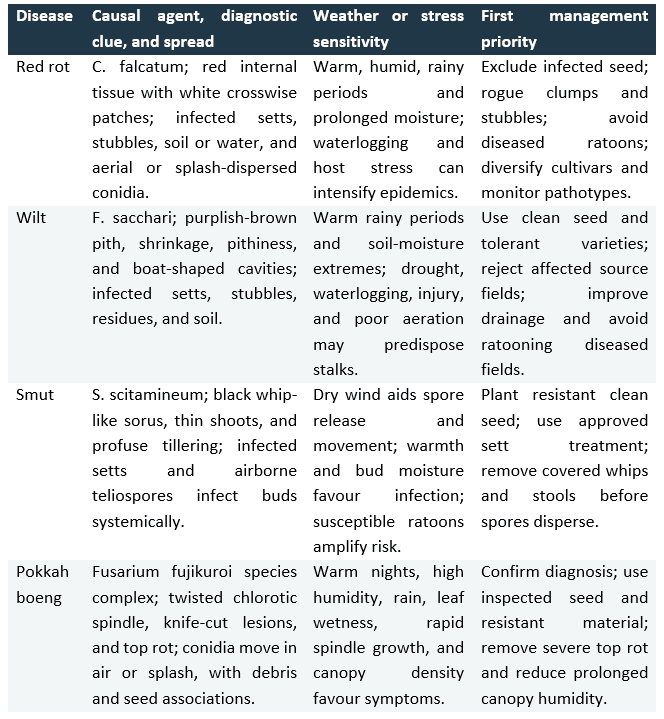
Sugarcane supports farm income and the rural processing economy of North India, yet its productivity and seed-cane security are repeatedly threatened by four important fungal diseases: red rot, wilt, smut, and pokkah boeng. Red rot, caused by Colletotrichum falcatum, remains the most destructive because infected planting material, aerial and local spread, pathogen variation, and large areas under a genetically uniform cultivar can combine to produce severe epidemics. The breakdown of Co 0238 resistance and the spread of pathotype CF13 illustrate this risk. Wilt, mainly associated with Fusarium sacchari, causes progressive drying, stalk shrinkage, internal purplish-brown discoloration, pithiness, and characteristic cavities; mixed infection with red rot can intensify stalk loss. Smut, caused by Sporisorium scitamineum, is both sett-borne and airborne and is recognized by its black whip-like sorus, thin shoots, and excessive tillering. Pokkah boeng is linked to a Fusarium fujikuroi species complex and ranges from chlorosis and twisting of young leaves to knife-cut lesions and top rot. Warm and humid periods, irregular rainfall, waterlogging, drought or heat stress, and changes in crop phenology may alter the timing and severity of these diseases. Evidence is strongest for short-term weather-disease relationships; direct attribution of individual outbreaks to long-term climate change remains limited. This review focuses on Uttar Pradesh, Bihar, Uttarakhand, Haryana, Punjab, and adjoining subtropical areas. It proposes an integrated framework based on clean and traceable seed, resistant-variety portfolios, rapid diagnosis, removal of inoculum, avoidance of diseased ratoons, drainage, balanced crop nutrition, need-based registered treatments, and district-level surveillance.
Downloads
References
Bao, Y., Akbar, S., Yao, W., Xu, Y., Xu, J., Powell, C. A., Chen, B., & Zhang, M. (2023). Genetic diversity and pathogenicity of Fusarium fujikuroi species complex causing sugarcane pokkah boeng disease in China. Plant Disease, 107(5), 1299–1309. https://doi.org/10.1094/PDIS-07-22-1639-SR
Bhuiyan, S. A., Magarey, R. C., McNeil, M. D., & Aitken, K. S. (2021). Sugarcane smut, caused by Sporisorium scitamineum, a major disease of sugarcane: A contemporary review. Phytopathology, 111(11), 1905-1917. https://doi.org/10.1094/PHYTO-05-21-0221-RVW
Chhabra, M. L., Parameswari, B., & Pandey, S. K. (2020). Current status and management of sugarcane smut disease in North India. Bhartiya Krishi Anusandhan Patrika, 35(3), 159-164. https://doi.org/10.18805/BKAP237
Costa, M. M., Melo, M. P., Guimarães, E. A., Veiga, C. M. O., Sandin, F. C., Moreira, G. M., Costa, S. S., & Pfenning, L. H. (2019). Identification and pathogenicity of Fusarium species associated with pokkah boeng of sugarcane in Brazil. Plant Pathology, 68(7), 1350–1360. https://doi.org/10.1111/ppa.13053
Hossain, M. I., Ahmad, K., Siddiqui, Y., Saad, N., Rahman, Z., Haruna, A. O., & Bejo, S. K. (2020). Current and prospective strategies on detecting and managing Colletotrichum falcatum causing red rot of sugarcane. Agronomy, 10(9), 1253. https://doi.org/10.3390/agronomy10091253
Krishnan, R., Sanjay, J., Gnanaseelan, C., Mujumdar, M., Kulkarni, A., & Chakraborty, S. (Eds.). (2020). Assessment of climate change over the Indian region: A report of the Ministry of Earth Sciences (MoES), Government of India. Springer. https://doi.org/10.1007/978-981-15-4327-2
Kumar, D., & Mukhopadhyay, R. (2025). Climate change and plant pathogens: Understanding dynamics, risks and mitigation strategies. Plant Pathology, 74(1), 59–68. https://doi.org/10.1111/ppa.14033
Lin, Z., Xu, S., Que, Y., Wang, J., Comstock, J. C., Wei, J., McCord, P. H., Chen, B., Chen, R., & Zhang, M. (2014). Species-specific detection and identification of Fusarium species complex, the causal agent of sugarcane pokkah boeng in China. PLOS ONE, 9(8), e104195. https://doi.org/10.1371/journal.pone.0104195
Malathi, P., & Viswanathan, R. (2012). Variation in Colletotrichum falcatum–red rot pathogen of sugarcane in relation to host resistance. Sugar Tech, 14(2), 181–187. https://doi.org/10.1007/s12355-012-0150-4
Minnatullah, M., Chand, H., Paswan, S., & Singh, S. P. (2020). Influence of weather on pokkah boeng disease in sugarcane under North-West Alluvial Plains (Zone I) of Bihar. Journal of Agrometeorology, 22(1), 60–62. https://doi.org/10.54386/jam.v22i1.124
Msomba, B. H., Ndaki, P. M., & Joseph, C. O. (2024). Sugarcane sustainability in a changing climate: A systematic review on pests, diseases, and adaptive strategies. Frontiers in Agronomy, 6, 1423233. https://doi.org/10.3389/fagro.2024.1423233
Poorniammal, R., Jernisha, J., Prabhu, S., & Dufossé, L. (2024). Sugarcane pokkah boeng disease: Insights and future directions for effective management. Life, 14(12), 1533. https://doi.org/10.3390/life14121533
Raj, C., Singh, S., Viswanathan, R., Ramesh Sundar, A., & Appunu, C. (2025). Insights into the role of climate change on major sugarcane diseases and their mitigation strategies. Sugar Tech. Advance Online Publication. https://doi.org/10.1007/s12355-025-01683-2
Rajput, M. A., Rajput, N. A., Syed, R. N., Lodhi, A. M., & Que, Y. (2021). Sugarcane smut: Current knowledge and the way forward for management. Journal of Fungi, 7(12), 1095. https://doi.org/10.3390/jof7121095
Tiwari, R., Shukla, S. K., Jaiswal, V. P., Sharma, L., Joshi, D., Chandra, K., Gaur, A., Srivastava, A., & Tiwari, R. K. (2021). Bio-control potential of Trichoderma spp. against Fusarium spp., the incitants of pokkah boeng disease of sugarcane under in-vitro conditions. Indian Phytopathology, 74, 691–701. https://doi.org/10.1007/s42360-021-00344-0
Viswanathan, R. (2020). Fusarium diseases affecting sugarcane production in India. Indian Phytopathology, 73, 415–424. https://doi.org/10.1007/s42360-020-00241-y
Viswanathan, R. (2021a). Red rot of sugarcane (Colletotrichum falcatum Went). CAB Reviews, 16, Article 023. https://doi.org/10.1079/PAVSNNR202116023
Viswanathan, R. (2021b). Sustainable sugarcane cultivation in India through threats of red rot by varietal management. Sugar Tech, 23, 239–253. https://doi.org/10.1007/s12355-020-00882-3
Viswanathan, R. (2022). Emerging diseases of sugarcane and new disease management strategies. Journal of Sugarcane Research, 12(1), 1–15. https://doi.org/10.37580/JSR.2022.1.12.1-15
Viswanathan, R. (2023). Severe red rot epidemics in sugarcane in subtropical India: Role of aerial spread of the pathogen. Sugar Tech, 25, 1275–1277. https://doi.org/10.1007/s12355-023-01292-x
Viswanathan, R., Balaji, C. G., Selvakumar, R., Malathi, P., Ramesh Sundar, A., Prasanth, C. N., Chhabra, M. L., & Parameswari, B. (2017). Epidemiology of Fusarium diseases in sugarcane: A new discovery of the same Fusarium sacchari causing two distinct diseases, wilt and pokkah boeng. Sugar Tech, 19, 638–646. https://doi.org/10.1007/s12355-017-0552-4
Viswanathan, R., Rao, G. P., & Solomon, S. (2021). Measures to minimize the growing menace of red rot of sugarcane in subtropical India. Sugar Tech, 23, 1207–1210. https://doi.org/10.1007/s12355-021-01013-2
Viswanathan, R., Selvakumar, R., Manivannan, K., Nithyanandam, R., & Kaverinathan, K. (2020). Pathogenic behaviour of soil-borne inoculum of Colletotrichum falcatum in causing red rot in sugarcane varieties with varying disease resistance. Sugar Tech, 22, 485–497. https://doi.org/10.1007/s12355-020-00800-7
Viswanathan, R., & Selvakumar, R. (2020). Varietal breakdown to red rot in sugarcane revealed by comparing two Colletotrichum falcatum inoculation methods. Sugar Tech, 22, 1063–1075. https://doi.org/10.1007/s12355-020-00855-6
Viswanathan, R., Singh, S. P., Selvakumar, R., Singh, D., Bharti, Y. P., Chhabra, M. L., Parameswari, B., Sharma, A., & Minnatullah, M. (2022). Varietal breakdown to red rot in the sugarcane variety Co 0238 mimics the Vertifolia effect: Characterizing new Colletotrichum falcatum pathotype CF13. Sugar Tech, 24, 1479–1496. https://doi.org/10.1007/s12355-021-01070-7
Viswanathan, R., Singh, S. P., Selvakumar, R., Raj, C., Singh, D., Bharti, Y. P., Chhabra, M. L., Sharma, A., Minnatullah, M., Mehra, R., Yadav, H. S., Goswami, S. K., Singh, S., & Tiwari, R. K. (2025a). Widespread occurrence of Colletotrichum falcatum pathotype CF13 in subtropical India dictates continuous pathogenic virulence and severe sugarcane crop destructions. Sugar Tech, 27, 1397–1408. https://doi.org/10.1007/s12355-025-01587-1
Viswanathan, R., Selvakumar, R., Raj, C., Gopi, R., Malathi, P., Ramesh Sundar, A., Annadurai, A., Balasaravanan, S., Nithyanantham, R., Kaverinathan, K., & Manivannan, K. (2025b). Molecular mapping and diversity of Fusarium isolates associated with wilt and pokkah boeng of sugarcane in tropical India. Sugar Tech. Advance Online Publication. https://doi.org/10.1007/s12355-025-01646-7
Xu, S., Wang, J., Wang, H., Bao, Y., Li, Y., Govindaraju, M., Yao, W., Chen, B., & Zhang, M. (2019). Molecular characterization of carbendazim resistance of Fusarium species complex that causes sugarcane pokkah boeng disease. BMC Genomics, 20, 115. https://doi.org/10.1186/s12864-019-5479-6
Zhao, D., & Li, Y.-R. (2015). Climate change and sugarcane production: Potential impact and mitigation strategies. International Journal of Agronomy, 2015, 547386. https://doi.org/10.1155/2015/547386zzzzz
Published
How to Cite
Issue
Section
License
Copyright (c) 2026 Everest Shiwach, Sandeep Kumar

This work is licensed under a Creative Commons Attribution 4.0 International License.


